
Electric vs Gas Go-Karts: Key Differences Explained
May 8, 2026
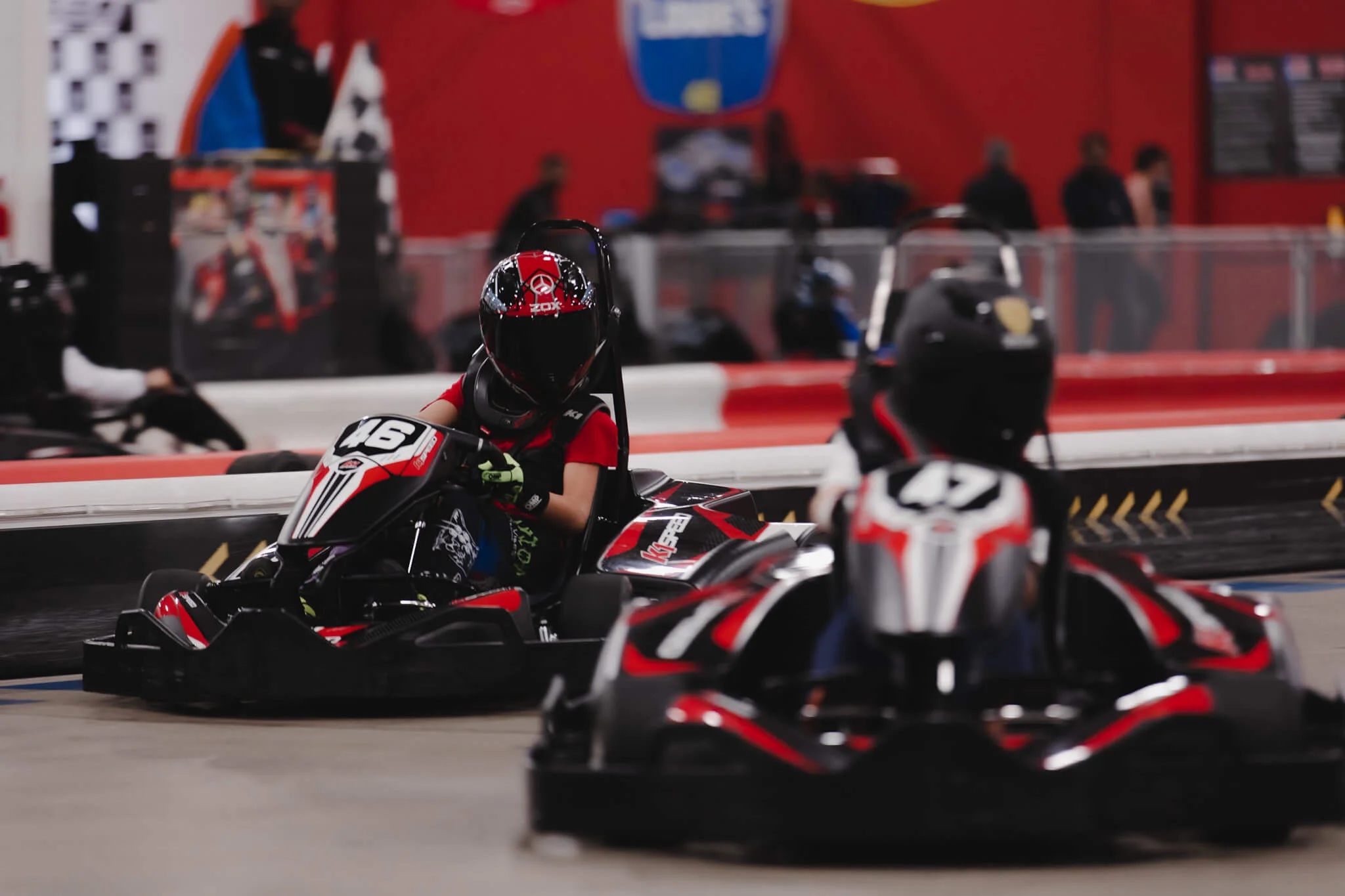
When comparing electric vs gas go-karts, electric karts win on every metric that matters for indoor racing: they deliver instant torque, maintain consistent lap-to-lap power, produce zero fumes, and run quietly enough to support a full evening of food and entertainment alongside the racing. K1 Speed Canada's electric karts reach up to 45 mph (72 km/h) with no engine lag, making every session feel faster and more competitive than a comparable gas-powered track. Whether you're a first-timer or a returning racer, the electric vs gas go-karts debate ends the moment you press the pedal.
Why the Type of Kart Changes Everything
You’re planning a night out. Maybe it’s a birthday celebration, a team outing, or a group chat that’s tired of the same dinner reservation. Someone suggests go-karting. The idea sticks immediately. But a question comes up quickly: electric vs gas go-karts, which one is actually better?
If you’ve only seen outdoor gas-powered karts before, the difference might not be obvious. But the type of kart dramatically changes the experience on the track. Acceleration, noise levels, control, and even how competitive a race feels are all affected by whether the kart runs on electricity or gas.
At K1 Speed Canada, the experience is built around high-performance electric go-karts designed specifically for indoor racing. The result is a smoother, faster, and more responsive driving experience that works for beginners and competitive racers alike.
Understanding the electric vs gas go-karts difference helps you choose the experience that actually delivers.
Electric vs Gas Go-Karts: Understanding the Difference
The comparison of electric vs gas go-karts refers to the two main types of powertrains used in recreational kart racing. Each has distinct characteristics that shape the driving experience in meaningful ways.
Gas Go-Karts
Gas-powered karts use a small combustion engine, similar in concept to a lawnmower engine, that runs on gasoline and produces power through mechanical combustion. These karts have traditionally dominated outdoor tracks and amusement-style venues. They produce audible engine noise, emit exhaust fumes, and require warm-up time before delivering peak power. Performance can also vary between sessions as fuel levels drop and the engine temperature fluctuates.
Electric Go-Karts
Electric karts use high-performance motors powered by rechargeable battery packs. These motors deliver torque immediately, the moment you press the pedal, the kart accelerates. There is no build-up, no lag, no warm-up period. Electric go-karts are the standard choice for modern indoor karting venues precisely because they offer control, consistency, and performance that gas engines cannot match in an enclosed space.
For guests visiting K1 Speed Canada’s locations, this distinction matters. The type of kart directly impacts how fast the kart accelerates, how smooth the driving experience feels, how consistent lap times are, and the overall atmosphere of the venue.
Performance Differences: Why Electric Go-Karts Feel Faster
One of the biggest factors in the electric vs gas go-karts debate is what happens the instant you press the accelerator. Gas engines require a short moment to build power through combustion cycles. Electric motors deliver torque immediately, with no lag between driver input and kart response.
This instant acceleration is especially noticeable when exiting tight corners. Gas karts ease into power as the engine catches up; electric karts launch out of the corner the moment you open the throttle. Over a 14-lap session, those fractions of a second compound into a genuinely different racing experience.
At K1 Speed Canada, the electric karts also maintain consistent power delivery throughout every session. Because there's no fuel to deplete and no engine temperature variance to manage, the kart on your fourteenth lap performs identically to the kart on your first. This is one of the clearest advantages when comparing electric go-karts vs gas karts: the data you see on the lap timing screen reflects your driving skill, not equipment variation.
K1 Speed Canada's 20-horsepower electric karts reach speeds of up to 45 km/h for adult karts, the fastest available at any indoor karting venue in Canada.
The Indoor Experience: Why Electric Karts Belong Inside
The electric vs gas go-karts question also comes down to where the karts are being used. Gas-powered karts create exhaust fumes and sustained engine noise that make them poorly suited to enclosed venues. Extended exposure to exhaust in an indoor space requires expensive and extensive ventilation infrastructure, and even then, air quality remains a concern.
Electric karts solve both problems entirely. No combustion means no exhaust. Quieter motors mean the venue atmosphere stays manageable. The difference isn't subtle: at K1 Speed Canada, you can have a full conversation in the Paddock Lounge while watching the track monitors, something that would be difficult or impossible at a gas-powered indoor venue.
This clean environment is what makes the full Eat. Play. Race. experience possible. Guests move seamlessly between racing sessions on the indoor track, arcade games, and the Paddock Lounge restaurant without the smell or noise of combustion engines following them through the venue. The evening flows naturally rather than feeling like a pitstop between loud, fume-heavy race sessions.
Environmental health guidance from Health Canada on indoor air contaminants highlights the importance of indoor air quality in enclosed public spaces, a standard that electric karting venues are uniquely well-positioned to meet compared to their gas-powered counterparts.
Consistency and Competition: The Lap Timing Advantage
For venues that operate competitive lap timing systems, the electric vs gas go-karts performance consistency difference is significant. Gas engines introduce variables: fuel consumption across a session, temperature changes, and mechanical wear between maintenance cycles all create slight power variations from kart to kart and lap to lap.
Electric motors provide stable, repeatable output every single lap. At K1 Speed Canada, racers receive detailed results after each session, fastest lap, overall race position, and personal improvement metrics. Because every kart in the session performs consistently, those results are a genuine measure of driver skill. There's no "I got the slow kart" conversation after the race ends.
This makes electric go-karts vs gas karts a straightforward choice for:
- Corporate team building competitions where fair comparison matters
- Birthday race tournaments where every guest deserves the same equipment
- Competitive racing leagues where skill should determine the winner
- First-time racers who want their results to reflect their actual performance
Check current deals and promotions at K1 Speed Canada to plan a group or competitive session at any of the four Ontario locations.
What the Electric Karting Experience Actually Feels Like
Many first-time guests are surprised by how different electric karting feels compared to what they expected from the electric vs gas go-karts comparison. Instead of loud engines and constant vibration, the focus shifts entirely to the driving experience itself.
Racers consistently notice immediate acceleration when exiting corners, smooth and predictable steering response, tight and controlled racing lines that reward technique, and competitive lap timing results that make every session feel meaningful. The track becomes a space where small improvements matter, a slightly better corner entry, a cleaner exit, a lap time that drops by a half-second. That’s why guests frequently book a second race during the same visit.
Because once the leaderboard appears on screen, everyone wants another chance to move up.
K1 Speed Canada operates across Cambridge, Toronto, and Mississauga, all open year-round with the full electric kart experience.
Electric vs Gas Go-Karts: Which Is Better for Group Events?
Whether you’re organizing a birthday, corporate outing, date night, or casual friends’ night, the electric vs gas go-karts question has a practical answer: electric karts make group events easier, fairer, and more enjoyable for everyone involved.
Gas karts at outdoor venues introduce external variables, weather, engine inconsistency, noise, and fumes, that reduce the quality of the group experience. Electric indoor kart venues like K1 Speed eliminate those variables entirely. The focus stays on the competition and the people you’re with.
K1 Speed Canada offers dedicated packages for birthday celebrations and corporate team events across all four Ontario locations. Groups of 10 or more are encouraged to reserve in advance through K1 Speed to secure reserved track time.
The Electric vs Gas Go-Karts Verdict Is Clear
Whether you're organizing a birthday, corporate outing, date night, or casual friends' night, the electric vs gas go-karts question has a practical answer: electric karts make group events easier, fairer, and more enjoyable for everyone involved.
Gas karts at outdoor venues introduce external variables, weather, engine inconsistency, noise, and fumes, that reduce the quality of the group experience. Electric indoor kart venues like K1 Speed eliminate those variables entirely. The focus stays on the competition and the people you're with.
K1 Speed Canada offers dedicated packages for birthday celebrations and corporate team events across all four Ontario locations.
Groups of 10 or more are encouraged to reserve in advance through K1 Speed to secure reserved track time.
Frequently Asked Questions: Electric vs Gas Go-Karts
1. Are electric go-karts faster than gas go-karts?
Electric karts often feel faster because they deliver instant torque with no engine lag. When you press the accelerator, power is delivered immediately, unlike gas engines, which require a brief moment to build through combustion cycles. At K1 Speed Canada, adult electric karts reach up to 45 km/h.
2. Do electric go-karts perform consistently throughout a race session?
Yes. Unlike gas karts, which can lose power as fuel depletes and engine temperature fluctuates, electric karts deliver the same output on every lap. This consistency is one of the key advantages of electric go-karts vs gas karts for competitive lap timing, because results reflect driver skill rather than equipment variation.
3. Are electric go-karts safer than gas go-karts for indoor use?
Electric karts are significantly better suited to indoor environments. They produce no exhaust fumes, which eliminates the air quality concerns associated with gas-powered karts in enclosed spaces. K1 Speed Canada’s karts are also equipped with electronic governors that allow track staff to remotely slow or stop any kart in real time, adding an additional layer of safety.
4. Do you need racing experience to race at K1 Speed Canada?
No racing experience is required. K1 Speed operates an arrive-and-drive format, meaning anyone can sign up, attend a short safety briefing, and race the same day.
5. Is K1 Speed Canada open year-round?
Yes. Because the tracks are fully indoors, racing is available year-round regardless of weather across Ontario.
6. How long does a typical visit to K1 Speed Canada last?
Most guests spend 90 minutes to 2 hours at the venue depending on how many races they book. Many visitors extend their evening by enjoying the arcade and the Paddock Lounge restaurant after racing.
7. Does K1 Speed Cambridge offer any promotions?
Yes. The Cambridge is the only K1 Speed Canada venue offering weekday and Sunday pricing promotions, making it the best value option for off-peak group visits in the Waterloo Region.
Ready to Feel the Difference? Book Your Electric Kart Session
The electric vs gas go-karts comparison is interesting in theory, but the real answer comes from behind the wheel. K1 Speed Canada's electric karts deliver instant torque, consistent performance, and a racing experience that surprises first-timers and satisfies returning competitors in equal measure.
Book your race at K1 Speed Canada open year-round across Cambridge, Toronto, and Mississauga.
Key Takeaways
- In the electric vs gas go-karts debate, electric karts deliver instant torque with zero engine lag, making them feel faster out of corners in every session.
- Electric go-karts maintain consistent power output lap after lap, so lap timing results reflect driver skill rather than equipment variation.
- Zero exhaust emissions and quieter motors make electric go-karts the only practical choice for indoor karting venues.
- The clean, quiet indoor environment enables the full K1 Speed Eat. Play. Race. experience, racing, arcade, and the Paddock Lounge all in one visit.
- K1 Speed Canada's adult electric karts reach up to 45 km/h, the fastest indoor electric karting experience available in Ontario.
- All four K1 Speed Canada locations, Cambridge, Toronto, and Mississauga, are open year-round with no experience required.
- The Cambridge location offers exclusive weekday and Sunday pricing promotions for groups looking for added value.
BLOG | CONTACT | FAQs | RULES | CAREERS | BOOK ONLINE | GIFT CARDS
© K1 SPEED, INC. ALL RIGHTS RESERVED