
What Makes a Track Section Feel Fast at K1 Speed
August 8, 2026
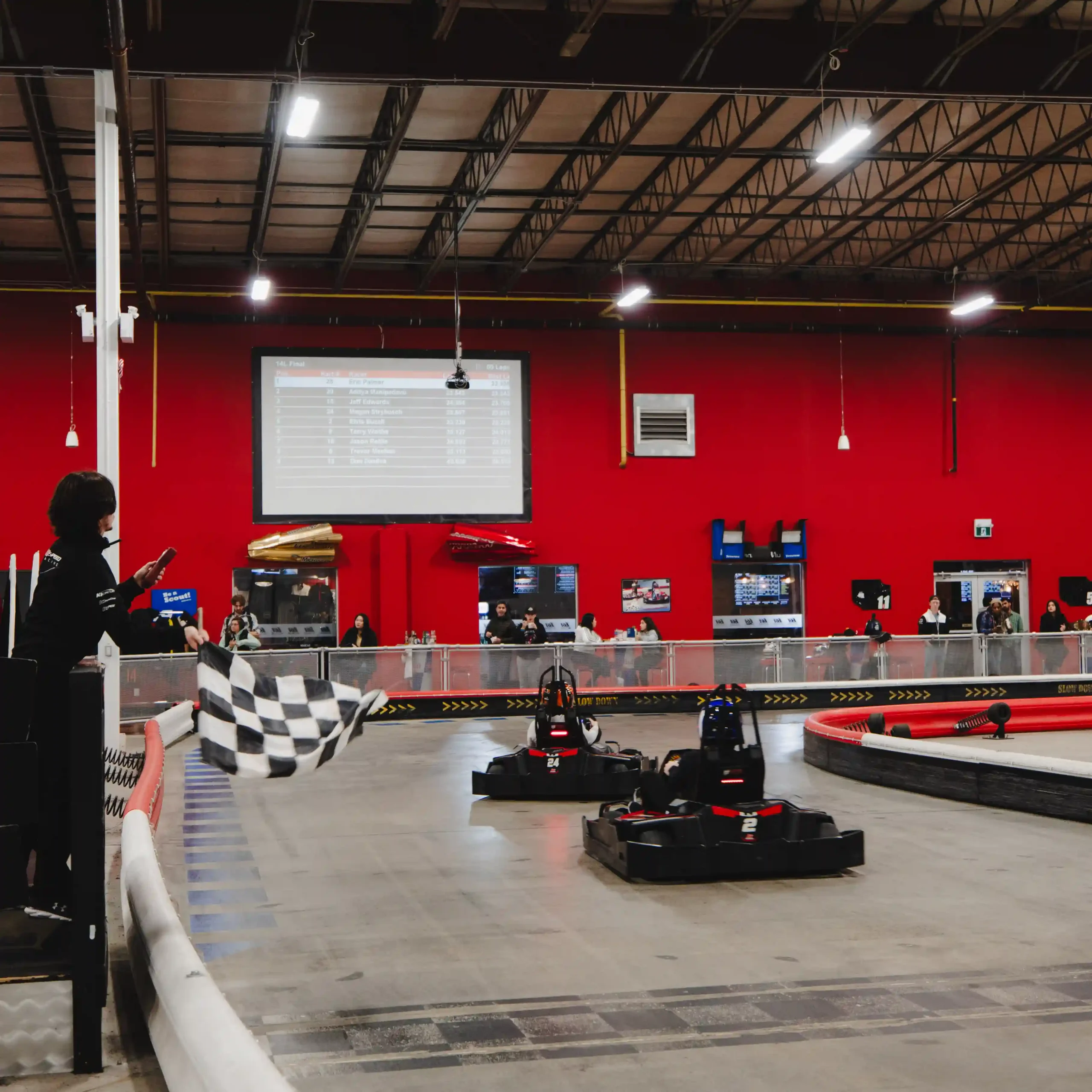
Speed on a kart track comes down to design: straightaway length, corner radius, and how sections connect. Toronto, Mississauga, and Cambridge each have their own track character, and understanding what creates a fast section helps you read any of the three differently the next time you race.
What Actually Makes a Section of Track Feel Fast?
A section feels fast when a driver can carry speed through it with minimal braking, which usually comes down to two things: straightaway length and corner radius. A long straight gives a kart room to build real speed before the next braking zone, while a wide, sweeping corner lets a driver carry more speed through the turn than a tight, sharp one would allow. Sections that combine both, a long approach into a wide corner, tend to be the fastest and most memorable parts of any track.
How Do Toronto, Mississauga, and Cambridge Compare in Track Character?
Each K1 Speed location was designed with its own layout, and that means each track rewards a slightly different driving style. Some sections favor a driver who can carry speed smoothly through a wider corner, while others reward sharp, precise braking into a tighter turn. Rather than one location simply being "faster" than another, each track has its own signature sections where a confident, committed driver can really open the kart up. Guests who race at more than one location often notice this difference immediately.
Why Do Longer Straightaways Create the Fastest Sections?
A longer straightaway gives a kart more distance to accelerate before the driver needs to brake again, which is why the longest straight on any track tends to be its signature fast section. These are the moments where a driver's confidence and smooth throttle control make the biggest difference, since even a slightly earlier or later brake point on a long straight has a real effect on the lap.
Throttle timing matters here as much as braking. A driver who gets back on the power early coming out of the corner before a straight builds more speed through the straight than one who waits until fully straightened out. Over several laps, that difference compounds into a measurable gap between drivers who are otherwise matched in cornering technique.
How Do Corner Design and Layout Affect Speed?
Wide, sweeping corners let a driver maintain more speed through the turn than a tight hairpin does, since there's more room to carry momentum without sliding wide. Track designers place these wider corners deliberately, often right after a long straight, to reward drivers who can carry speed confidently rather than braking too early out of caution.
Track width also plays a role. A wider corner gives a driver more room to find the ideal racing line, which usually means a gentler arc through the turn and less speed lost to steering lock. Tighter corners compress that margin, which is why they tend to feel slower even when the kart's actual entry speed isn't much different.
How Is This Different From Improving Your Own Lap Times?
Understanding track design explains why a section is fast in the first place, while techniques like braking points and cornering lines, covered in our braking tips guide and cornering tips guide, are about how you personally drive that section faster. Knowing the layout gives you the map. Technique is how you execute it.
Reading the Track at Any K1 Speed Location
Every K1 Speed track has at least one section built to reward committed, confident driving, whether that's a long straight or a wide sweeping corner. Learning to recognize these sections, and pairing that knowledge with solid cornering stability, is part of what makes racing at more than one location interesting for regular racers.
Ready to find your favorite fast section? Find your nearest K1 Speed location in Toronto, Mississauga, or Cambridge and book your next session.
FAQs
1. Is one K1 Speed location faster than the others?
Each track has its own layout and character rather than one location simply being faster overall. Different sections reward different driving styles, so regular racers often develop a preference for one track's rhythm over another.
2. What makes a straightaway feel like the fastest part of a track?
A longer straightaway gives a kart more room to build speed before the next braking zone, which is why the longest straight on any track tends to be its most memorable fast section.
3. Do wider corners really allow more speed?
Yes. A wide, sweeping corner lets a driver carry more speed through the turn than a tight hairpin, since there's more room to hold the racing line without sliding wide.
4. Can I race at all three K1 Speed locations to compare?
Yes. Many regular racers visit more than one location specifically to experience how each track's layout changes their approach and racing rhythm.
5. Does track design affect strategy in Challenge GP?
Yes. Knowing where a track's fastest sections are helps drivers plan braking points and passing opportunities more effectively across a full Challenge GP night.
Key Takeaways
- Track speed comes down to straightaway length and corner radius, not just raw track size.
- Toronto, Mississauga, and Cambridge each have their own track character and signature fast sections.
- Longer straightaways reward smooth throttle control and confident braking timing.
- Wide, sweeping corners allow more carried speed than tight hairpins.
- Understanding track design complements driving technique, it doesn't replace it.
BLOG | CONTACT | FAQs | RULES | CAREERS | BOOK ONLINE | GIFT CARDS
© K1 SPEED, INC. ALL RIGHTS RESERVED