
How Fast Do Indoor Go-Karts Go? Speed Facts Revealed
May 4, 2026
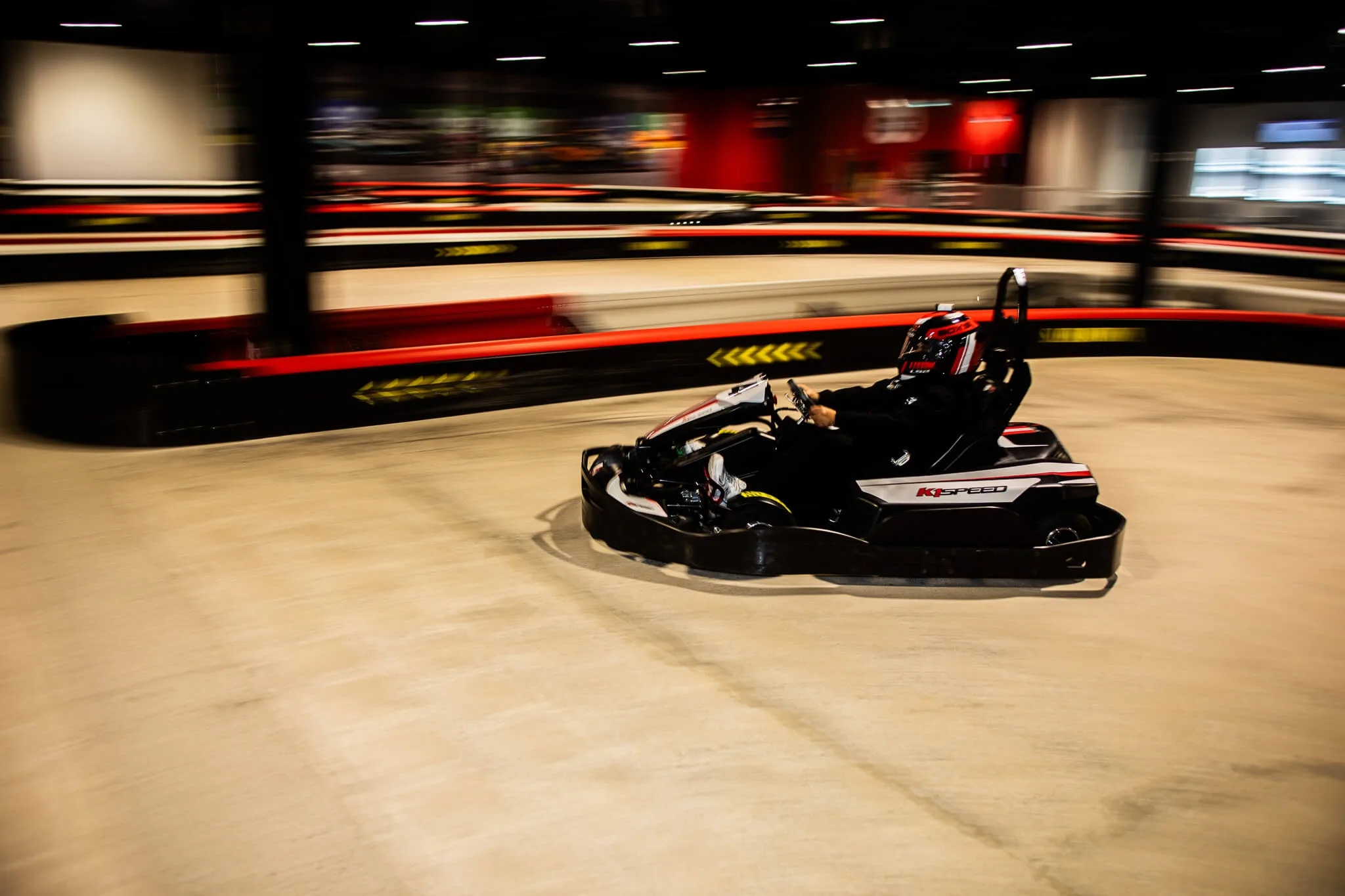
Indoor go-karts at K1 Speed Canada reach up to 45 mph (72 km/h), powered by electric motors that deliver instant torque with zero lag. The combination of a low seat position, tight technical corners, and live lap timing makes the electric go-kart speed feel significantly faster than the number suggests, and the karts maintain consistent performance every single session.
The Question Everyone Asks Before Their First Session
It comes up every time. Someone in the group has been go-karting before, somewhere with gas-powered karts that topped out at a speed you'd describe as "fine", and they're skeptical. Is this actually fast? Are we talking bumper cars with a better marketing budget, or something that's going to feel genuinely quick?
It's a fair question, and the answer matters. Speed is one of the main reasons people come back to K1 Speed Canada. The karts are quick, the acceleration is immediate, and the track is designed to make you feel every bit of how fast indoor go-karts go.
Here's an honest breakdown of how fast indoor go-karts go, what makes electric karts perform differently from gas, and why the experience at K1 Speed hits differently than most people expect.
How Fast Do Indoor Go-Karts Go? The Actual Numbers
K1 Speed’s adult electric karts reach speeds of up to 45 mph (roughly 72 km/h). On a purpose-built indoor track with tight corners and elevation changes, that translates to a driving experience that feels considerably faster than the number suggests.
Context matters here. A car doing 45 mph on a highway barely registers. A kart doing 45 mph, six inches off the ground, on a track where the walls are close and the corners come quickly, is a different situation entirely. The physical sensation, the lateral G-force through corners, the acceleration out of a tight turn, is what makes the electric go-kart speed feel so real.
Junior karts, used for younger racers, operate at lower speeds (up to 30 km/h) with the same electric drivetrain. Both formats use live lap timing so every session produces real, comparable data, not just an impression of how fast you went.
Electric vs. Gas Go-Karts: Why the Difference Matters
Most casual go-karting venues run gas-powered karts. K1 Speed Canada runs electric, and that distinction shapes the entire experience of how fast indoor go-karts go, not just the environmental footprint.
Instant Torque
Electric motors deliver torque immediately, there’s no rev-building, no lag between input and response. When you press the accelerator on an electric kart, the kart moves. That responsiveness is one of the defining characteristics of the K1 Speed experience and a big part of why the electric go-kart speed feels so immediate.
Consistent Performance Across Every Session
Gas karts lose performance as they run. The engine warms, fuel depletes, and the kart at the end of a session isn’t performing the same as the kart at the start. Electric karts maintain consistent output throughout. The kart you get at the start of your session performs the same way on your final lap, which means your lap timing data is actually measuring your driving, not engine variation.
A Cleaner, Quieter Environment
No exhaust means no fumes inside the venue. The Paddock Lounge, the spectator areas, the restaurant, all of it stays clean and breathable. The track is loud enough to be exciting, but the noise profile of electric karts is fundamentally different from the exhaust-heavy din of gas-powered venues. You can actually have a conversation in the stands.
This mirrors broader industry findings on electric kart technology. According to educational resources from ASN Canada FIA, advancements in electric kart technology are increasingly shaping how competitive karting is governed and experienced across Canada.
What Makes the Track Feel Fast
Speed on a go-kart track isn’t purely about top velocity. The design of the track determines how much of that speed you actually experience, and K1 Speed tracks are built to maximize that sensation of just how fast indoor go-karts go.
A few elements that shape the experience:
- Low seat position: Sitting six inches off the ground compresses perceived speed. The same velocity in a car versus a kart registers completely differently in your body.
- Corner frequency: Technical indoor tracks are designed with varied corner radii, tight hairpins, sweeping turns, and chicanes. The variety keeps every lap engaging and rewards drivers who learn the track across multiple sessions.
- Track surface: Indoor tracks use a consistent, maintained surface that gives the karts reliable grip. Predictable grip means you can push the kart harder with confidence, which is part of what makes improvement between sessions satisfying.
- Live lap timing: Knowing your lap time in real time gives the speed context. Shaving a second off your best lap is a measurable outcome, and it’s what turns a casual session into a competitive one.
These design principles align with industry safety and performance standards outlined by organizations like ASN Canada FIA Karting and reflect the track design philosophy covered in resources like XInsurance’s go-kart track safety and design guide.
Speed Is a Starting Point, Not the Whole Story
One of the things that separates K1 Speed from most indoor entertainment options is that the experience rewards skill. The karts are fast enough to be genuinely exciting on your first visit, but they’re also technical enough that a racer who has logged multiple sessions will be measurably faster than someone asking how fast indoor go-karts go for the first time.
That progression is part of the appeal. Arrive-and-drive sessions give you a baseline. Return visits let you test whether your technique has improved. K1 Speed also runs organized competitive racing events for drivers who want to take that further, timed qualifying, head-to-head heats, podium ceremonies.
One lap can change the way you think about the rest of the evening. Most people finish their first session and immediately want to know when they can come back.
Safety at Speed: How K1 Speed Keeps Every Session Controlled
Understanding how fast indoor go-karts go is one thing, knowing the safety systems behind those speeds is another. K1 Speed’s electric karts are equipped with electronic governors and remote control systems that allow track marshals to slow or stop any individual kart in real time.
Every racer completes a safety briefing and reviews the rules before their session, covering flag signals, track rules, and kart operation. Helmets and neck braces are provided and sanitized between sessions. The PROTEX barrier systems used at K1 Speed venues are among the safest in the indoor karting industry.
For an overview of karting safety standards and equipment requirements in Canada, the ASN Canada FIA Karting Regulations provide a comprehensive reference point.
Electric Go-Kart Racing Across Ontario: Cambridge, Toronto, and Mississauga
K1 Speed Canada operates four full venues in Ontario, each running the same electric kart platform with live lap timing and the full Eat. Play. Race. experience. Every location gives you the same answer to how fast indoor go-karts go: up to 45 mph, with every lap timed.
The Cambridge location serves the Waterloo Region, Kitchener, Waterloo, Guelph, and surrounding areas, and is the only K1 Speed Canada venue offering weekday and Sunday pricing promotions. If you’re planning a group night or a return visit during the week, Cambridge gives you more ways to get value from your session.
The Toronto and Mississauga locations serve the broader GTA, with easy access from North York, Scarborough, Etobicoke, Brampton, Oakville, and Burlington. All four locations are open year-round, indoor karting in Ontario doesn’t have an off-season.
Check the latest K1 Speed deals and promotions for current session pricing and offers across all locations.
The Speed Is Real, And That’s Just the Beginning
How fast do indoor go-karts go at K1 Speed Canada? Up to 45 mph, but the numbers only tell part of the story. Instant electric torque, a low-slung seat position, technical track design, and live lap timing combine into an experience that consistently surprises people who were expecting something more casual.
K1 Speed Canada is open year-round across four Ontario locations. Whether you’re here for your first session or working on a personal best, the electric karts perform the same way every time you’re in the seat.
Frequently Asked Questions About Indoor Go-Kart Speed
1. How fast do K1 Speed go-karts go?
K1 Speed’s adult electric karts reach up to 45 mph (approximately 72 km/h). On a tight indoor track, that electric go-kart speed translates into an experience that feels significantly faster than the number alone suggests, particularly through high-speed corners where lateral G-forces are constant. Junior karts reach up to 30 km/h.
2. Are electric go-karts faster than gas go-karts?
Not necessarily in top speed, but electric karts deliver torque instantly, there’s no lag between input and acceleration. That immediate response makes them feel faster out of corners and more reactive to driver input. Electric karts also maintain consistent performance throughout a session, whereas gas karts can lose power as they run. This is one of the key advantages of how K1 Speed’s electric karts are engineered.
3. Is indoor go-karting safe at those speeds?
Yes. K1 Speed venues are purpose-built for the speed the karts operate at, barrier systems, track design, and kart specifications are all aligned with the experience. Every racer completes a safety orientation before their first session, helmets and neck braces are provided, and track marshals monitor sessions in real time.
4. Do faster drivers have an advantage at K1 Speed?
Technique matters more than raw aggression. The karts are consistent across all racers in a session, so performance differences come down to cornering lines, braking points, and track knowledge. That’s part of what makes competitive racing at K1 Speed genuinely satisfying, skill is measurable, and improvement is real.
5. Is K1 Speed Canada open year-round?
Yes. All four K1 Speed Canada locations, Cambridge, Toronto, and Mississauga operate year-round. The indoor format means weather has no effect on the experience or the electric go-kart speed.
6. What is the maximum weight limit for K1 Speed karts?
The maximum weight for adult karts is approximately 300 lbs, and the maximum height is approximately 6’7”. Junior karts have a maximum height of around 5’3”.
7. Can I race at K1 Speed without a driver’s license?
Yes. No driver’s license is required to race at K1 Speed Canada. However, first-time visitors will need to present a valid piece of photo ID to confirm their identity for waiver completion. From there, a safety briefing is all you need before getting on track.
Book Your Session and Feel the Speed for Yourself
The answer to how fast indoor go-karts go is 45 mph, but the only way to truly understand what that feels like from six inches off the ground is to get in the seat.
Book your session at K1 Speed Canada no experience required.
Key Takeaways
- K1 Speed Canada's adult electric karts reach up to 45 mph (72 km/h), the fastest electric go-kart speed available at an indoor karting venue in Ontario.
- Electric karts deliver instant torque with zero lag, making them feel faster and more responsive than comparable gas-powered karts.
- The low seat position, tight track design, and live lap timing amplify how fast the electric go-kart speed feels in practice.
- Electric karts maintain consistent performance throughout every session, your lap times reflect your driving, not engine wear.
- K1 Speed Canada operates four year-round locations in Ontario: Cambridge, Toronto, and Mississauga.
- The Cambridge location offers exclusive weekday and Sunday pricing promotions.
- No driver's license or experience is needed, a safety briefing is all that stands between you and your first lap.
BLOG | CONTACT | FAQs | RULES | CAREERS | BOOK ONLINE | GIFT CARDS
© K1 SPEED, INC. ALL RIGHTS RESERVED